Sustainability goals
Because we believe that change starts from within, we have chosen to categorize our focus areas from the product — the core of everything we do — to the person and the planet.

Driving sustainable progress
Because we believe that change starts from within, we have chosen to categorize our focus areas from the product — the core of everything we do — to the individual and the planet.
PRODUCT
We work to solve our customers’ challenges through our broad product range and extensive experience. We want to use our capabilities to help create a more sustainable industry.
PEOPLE
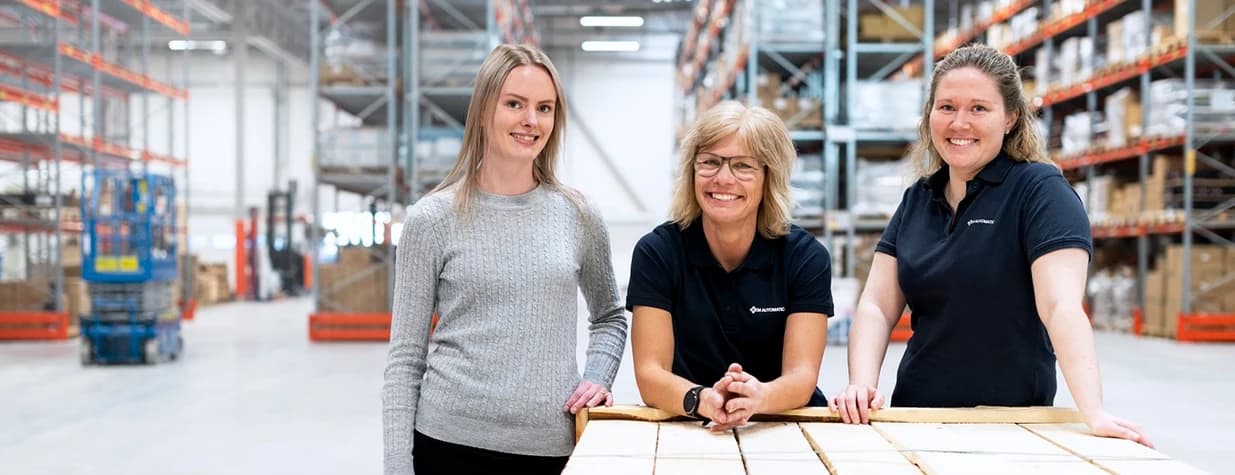
Behind every solution we deliver to our customers are our fantastic employees. Together, we want to thrive and grow in our workplace.
PLANET
Together with everyone else on this planet, we want to take responsibility by mapping and reducing our emissions.

Product
OEM’s products and solutions should contribute to a more circular economy and thereby to sustainable development.
Goals
1) Communicating product sustainability aspects in marketing communcation and sales processes
OUTCOME: This is already a natural part of the sales process and communication in large parts of the Group today.
2) Sustainability training within the organization
OUTCOME: During the year, the majority of the Group’s companies carried out activities aimed at strengthening sustainability competence.
3) Conducting supplier assessments of strategic suppliers
OUTCOME: During the year, OEM invested in a new Group-wide tool for supplier assessments. Assessments were sent to approximately 200 of the Group’s most strategic suppliers, which together represent around 85 percent of the purchasing volume.
4) Reducing the amount of electronical waste
OUTCOME: The amount of electronic waste is reduced through increased focus on product lifespan, circular handling, and responsible decommissioning of IT equipment. Overall, the work indicates a gradual transition toward more circular management of electronics over time, although the level of maturity varies between companies.
5) Increasing the share of recycled purchased packiging material
OUTCOME: The work focuses on gradually increasing the share of recycled purchased packaging material. During the year, the share amounted to approximately 40 percent.
Sustainable Solutions for the Future
Supporting customers in selecting the right components is a central part of OEM’s sustainability work. The focus is on products and solutions that reduce environmental impact and improve resource efficiency — for example through high efficiency, optimized processes, and reduced travel needs. Products with long service life, good repairability, and recyclability are a natural part of the offering and contribute to a more circular economy.
With deep product and application expertise as well as a broad product range, OEM provides a holistic perspective. Through close customer collaboration, components are combined into tailored solutions that improve operations, productivity, and total cost efficiency. When needed, this is carried out in cooperation with specialists to ensure technically and commercially optimal solutions.
OEM’s sustainability work is both a responsibility and a strategic opportunity. An offering with clear sustainability benefits strengthens competitiveness and creates new business opportunities. By integrating sustainability into sales processes, training, and supplier collaboration, OEM continues to develop its offering and contribute to long-term value creation.
OEM
1) The ambition is for the Employee Satisfaction Index (ESI) to exceed 4.0 in completed employee surveys. During 2025, companies should carry out ESI-improving activities based on the 2024 survey results.
OUTCOME: The ambition is to conduct employee surveys every second year. Between measurements, improvement activities are carried out based on results and learnings. During 2025, the majority of companies implemented such activities, mainly related to communication, dialogue, and daily follow-up. The next employee survey is planned for 2026.
2) At least 20% women in recruitment to sales and product roles, with the long-term aim of increasing the number of women in leadership positions
OUTCOME: 12%
3) Zero vision regarding workplace accidents
During 2025, all companies are expected to work to reduce the risk of accidents.
OUTCOME: Continuous and preventive occupational health and safety work is carried out through risk assessments, safety procedures, and training initiatives adapted to each operation. Overall, these efforts help reduce accident risks and support the Group’s zero vision for workplace accidents.
4) External employee turnover below 10%
OUTCOME: 13%
5) 96% attendance rate
OUTCOME: 97%
Suppliers
OEM shall promote good working conditions among suppliers and ensure compliance with requirements regarding human rights.
6) Signing of the OEM Supplier Code of Conduct in the S3 supplier chain
During 2025, the ambition is for all strategic suppliers of the Group’s companies to comply with and sign the OEM Supplier Code of Conduct.
OUTCOME: Approximately 50%
Inclusive Workplaces with Engaged Employees
A safe and well-functioning work environment, both internally and among suppliers, is a prerequisite for sustainable growth and long-term profitability. There is a clear connection between employee well-being and the development of the business. OEM therefore works systematically with occupational health and safety issues and structured follow-up of both physical and psychosocial factors.
The Group also sets clear requirements for suppliers regarding sustainability work and compliance with codes of conduct to ensure responsible conditions throughout the value chain. Gender equality is a prioritized area, with the ambition to gradually increase the share of women in new recruitment and thereby strengthen representation in leadership positions over time. Through inclusive communication and broader recruitment initiatives, OEM also contributes to a more gender-equal industry.
1) 50% reduction of emissions from properties by 2030 (Scope 1 and 2) – E1
1a) 100% renewable purchased energy
OUTCOME: 74.5%
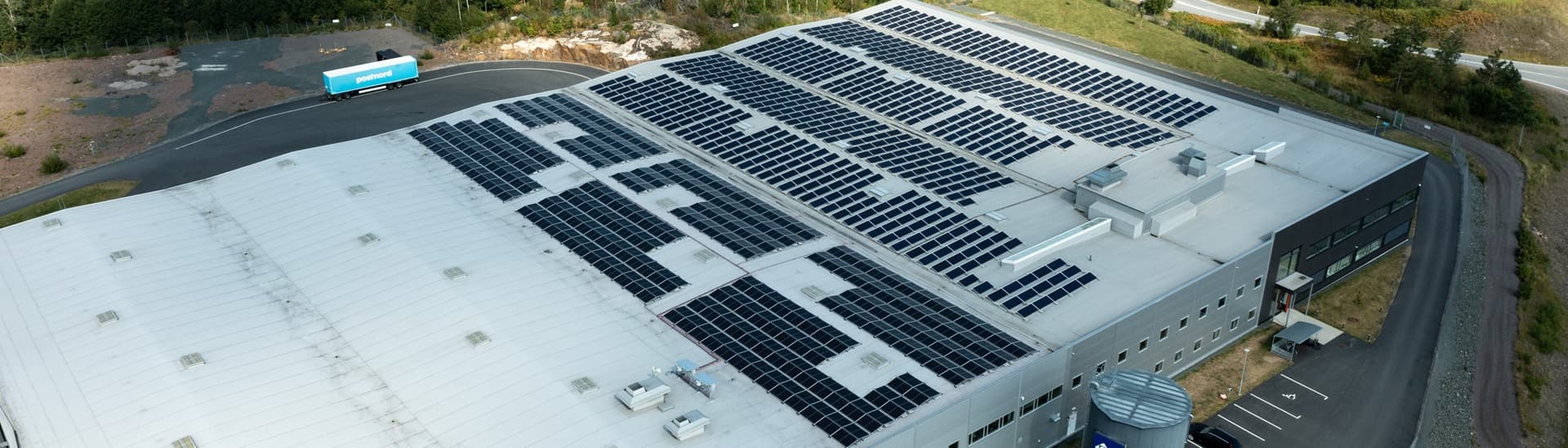
1b) Increase the share of self-generated energy
OUTCOME: 803 MWh (501 MWh)
2) 50% reduction of emissions from company cars by 2030 (Scope 1) – E1
2a) 100% fossil-independent vehicle fleet
OUTCOME: Through an updated car policy, the Group is driving a gradual transition of the vehicle fleet, where electric vehicles and plug-in hybrids are prioritized in new acquisitions across an increasing number of companies.
3) 50% reduction of emissions from freight transport by 2030
OUTCOME: During 2025, the companies worked to reduce emissions from freight transport through transport optimization, an increased share of sea freight, and the implementation of fossil-free alternatives in collaboration with logistics partners.
4) 50% reduction of emissions from business travel by 2030
OUTCOME: During 2025, emissions from business travel were reduced through measures such as electrification of the vehicle fleet, use of SAF fuel in air travel, and digital meetings.
5) 20% reduction of emissions from purchased products by 2030 (base year 2024) – E1
During 2025, the ambition is for companies to map the energy consumption and share of fossil-free energy among strategic suppliers through supplier assessments.
OEM’s environmental impact is largely linked to goods transportation, business travel, and energy use in properties. The Group’s goal is to reduce CO₂ emissions by 50 percent by 2030, using 2020 as the base year. To achieve this goal, OEM works systematically to improve the efficiency of its own operations and to influence customers and suppliers toward more sustainable choices.
Reporting is continuously being developed, particularly within Scope 3 in accordance with the GHG Protocol. More in-depth data collection and more accurate calculation methods strengthen transparency, even though this may affect year-on-year comparability as the scope of reporting expands and data quality improves.
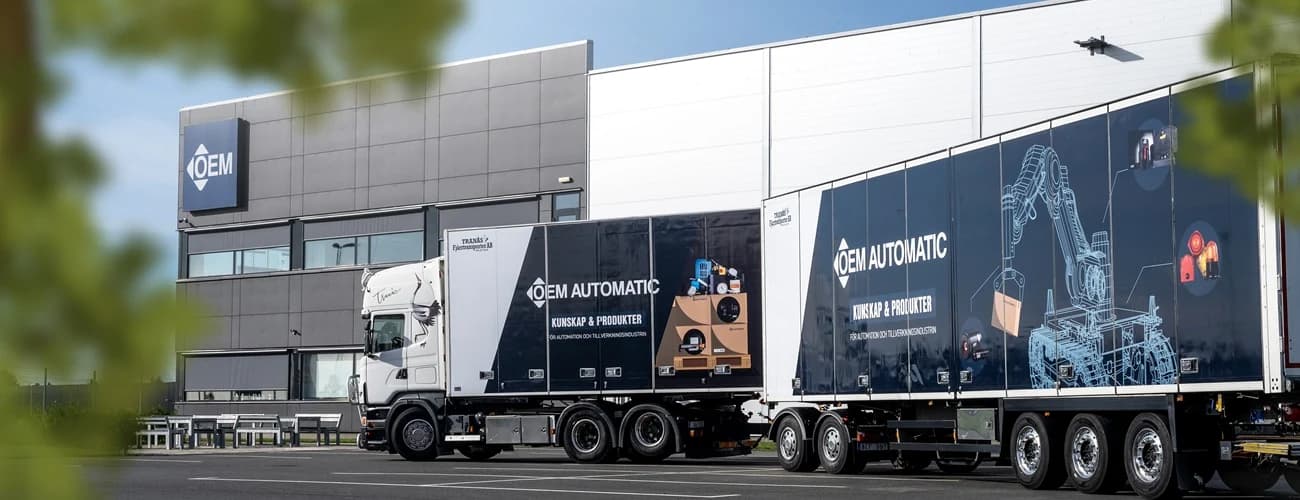
For a logistics-intensive company, transportation is a key challenge. Since 2023, sustainable marine fuel has been used in collaboration with Geodis to reduce emissions from sea transport. The transition to a fossil-independent vehicle fleet accelerated during 2024, supported by increased investments in charging infrastructure at the Group’s own properties. Pool cars are partly powered by HVO100, and electric cargo vehicles are used for time-critical transport, contributing to reduced emissions.
All companies work towards common sustainability goals while maintaining the mandate to develop local priorities. The work also includes GHG reporting and supplier assessments.