
Business model
How OEM International delivers value through four key processes

Broad portfolio, customisation and collaborative solutions
Customer value
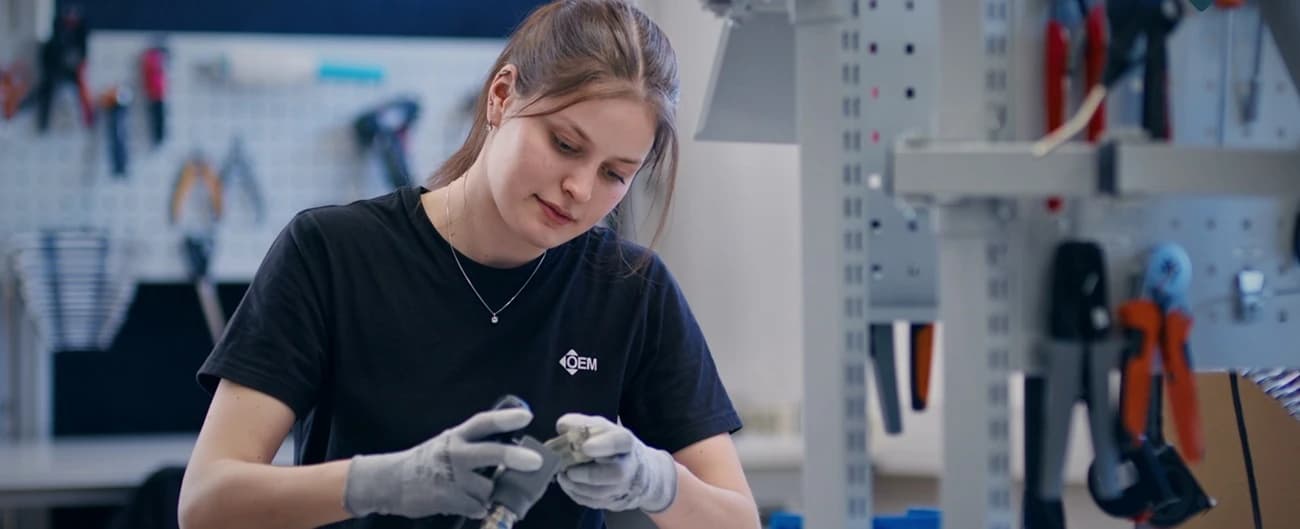
The core of the business model is a wide range of quality products from leading suppliers. The products are supplied both in standard versions or adapted to the customers’ unique wishes. The customisation is done either in one of the operations’ processing departments or, if the volumes are higher, directly at OEM's manufacturer. Examples of customisation can include a number of components being pre-assembled on delivery, or a product having a customised design such as an adjusted cable length with a mounted connector. Trusting and close co-operation with both customers and suppliers is the prerequisite for effective dialogue and a high level of creativity, which ultimately provides customers with unique product solutions that improve their end product. Continually developing the collaboration with customers gradually leads to the customers coordinating an ever greater proportion of their purchases with OEM. Knowledge, service, efficiency and quality are some of OEM's values that characterise the co-operation with customers. The employees' high level of knowledge of the operations’ product ranges and applications supports customers in choosing components, which creates both technical and financial value for customers
Value for suppliers
OEM’s operations are built on strong market engagement and well-functioning logistics flows. This creates the conditions to represent leading suppliers and build long-term trust. By acting as the manufacturers’ local representative, OEM takes overall responsibility for customer relationships and ongoing market development. The objective is to be the suppliers’ primary sales channel in each market and to contribute to strengthening their position within selected niches.
Cooperation with suppliers is characterized by close dialogue, loyalty, and long-term relationships. Over time, the organization has developed deep expertise in the suppliers’ products and their areas of application. This enables discussions around product development, where OEM contributes market insights and application knowledge. In this way, suppliers can develop offerings that meet customer needs and strengthen their competitiveness. OEM’s market position, with strong local presence, enables suppliers to reach customers that would otherwise be difficult to access on their own. In addition, OEM avoids marketing competing products.
During 2025, the Group initiated work to adapt its operations to increasing sustainability requirements within the supply chain. OEM creates customer value through a broad product range, deep product and application expertise, and customer-adapted refinement — from standard products to customer-specific solutions. The work includes monitoring working conditions, health and safety, corporate governance, and suppliers’ compliance with the Group’s Code of Conduct.
This adaptation involves expanding the Group’s requirements and strengthening follow-up procedures within the supplier chain.
The website as a competitive advantage
The operations’ websites are the basis for all customer information, where the product range is presented with all possible information. Customers should be able to easily navigate between well-structured product information, inspiration and knowledge, which makes the OEM companies' websites natural tools in their customers' everyday lives. The e-commerce functions streamline flows and become a natural tool in their customers' purchasing work.
Efficient logistics flows
The coordination between OEM's smaller warehouses and the larger logistics centres streamlines the flow of goods, resulting in both cost efficiency and high quality as well as improving service levels. Logistics for larger customers are tailored to their requirements, including mode of delivery, packaging and frequency of delivery, creating clear benefits for the customers. Ongoing work to improve efficiency and create well-functioning goods flows gradually increases accessibility, quality and the level of service.
What this means for our manufacturers:
- Assistance with marketing in local markets.
- Can have their products marketed with complementary products.
- Reach markets and customers that are difficult to reach when acting alone.
- Help with product customisation.
- Logistics solutions that meet customer demands.
- Feedback for their own product development.
What this means for our customers:
- Access to components from more than 400 manufacturers.
- In-depth component knowledge.
- End-to-end solutions with complementary components.
- Possibility to reduce the number of manufacturers.
- Deliveries to the right place at the right time.
- Assurance of high product quality.